Rules and ethics
Part of Can sole traders claim R&D tax relief in the UK?
Can sole traders claim R&D tax relief in the UK?
Sole traders cannot claim the SME R&D tax credit. This guide explains HMRC's company rules, the RDEC confusion and the routes open to unincorporated firms.
What to take away
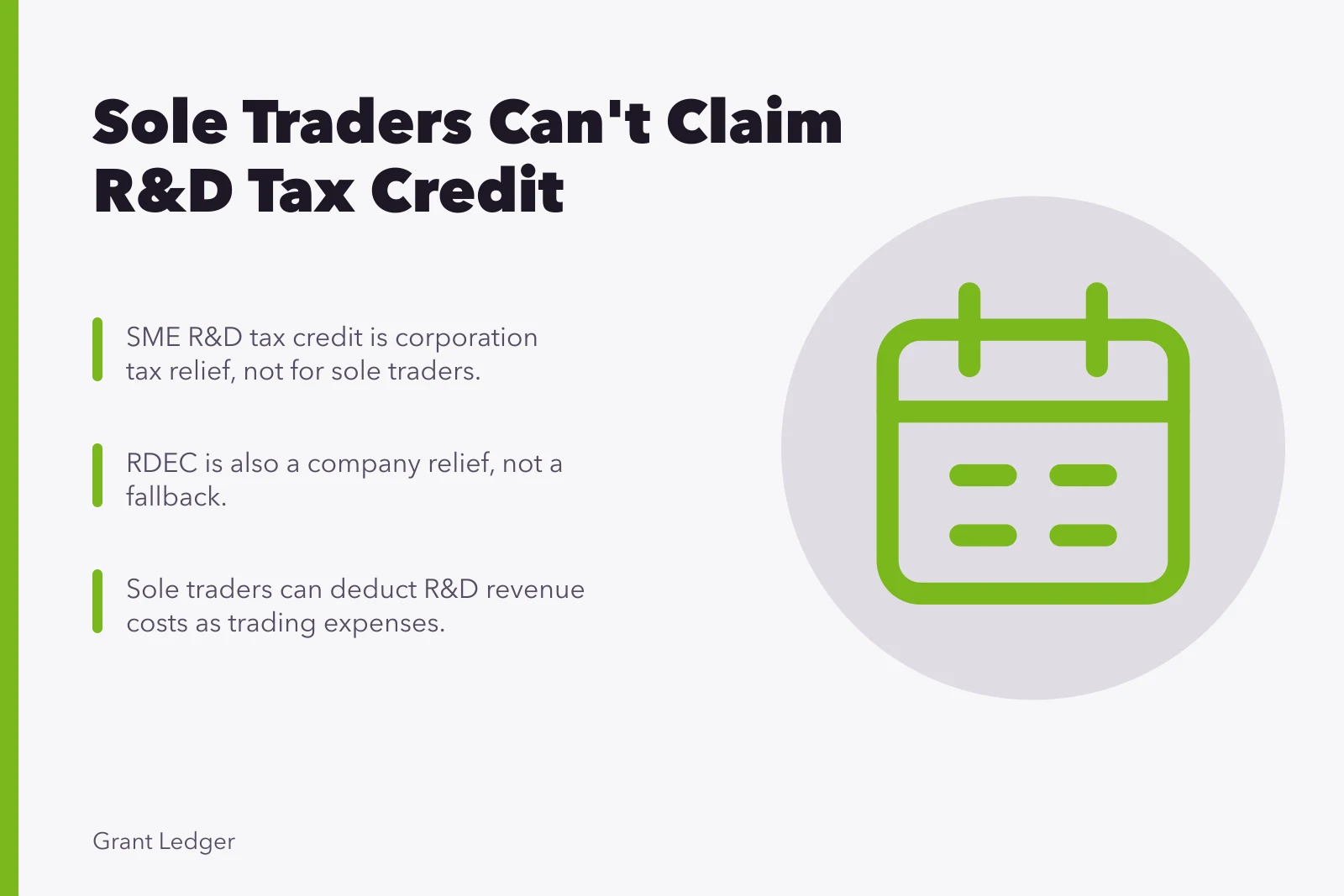
- A sole trader cannot claim the SME R&D tax credit, because HMRC's company schemes run through corporation tax.
- RDEC is also a company relief. It is not a fallback for an unincorporated trader.
- A sole trader can usually deduct qualifying R&D revenue costs as ordinary trading expenses, and may claim capital allowances for R&D capital spending.
- Incorporating can open the company schemes, but it changes tax, ownership and compliance.
- Take advice for your own case; the rules depend on facts and dates.
Why the SME scheme is closed to sole traders
The SME R&D tax credit is a corporation tax relief. It is available to companies that meet the SME definition and carry out qualifying R&D. HMRC's guidance on Research and Development (R&D) tax relief sets out the company conditions. A sole trader pays income tax, not corporation tax, so the SME scheme cannot apply in their own name.
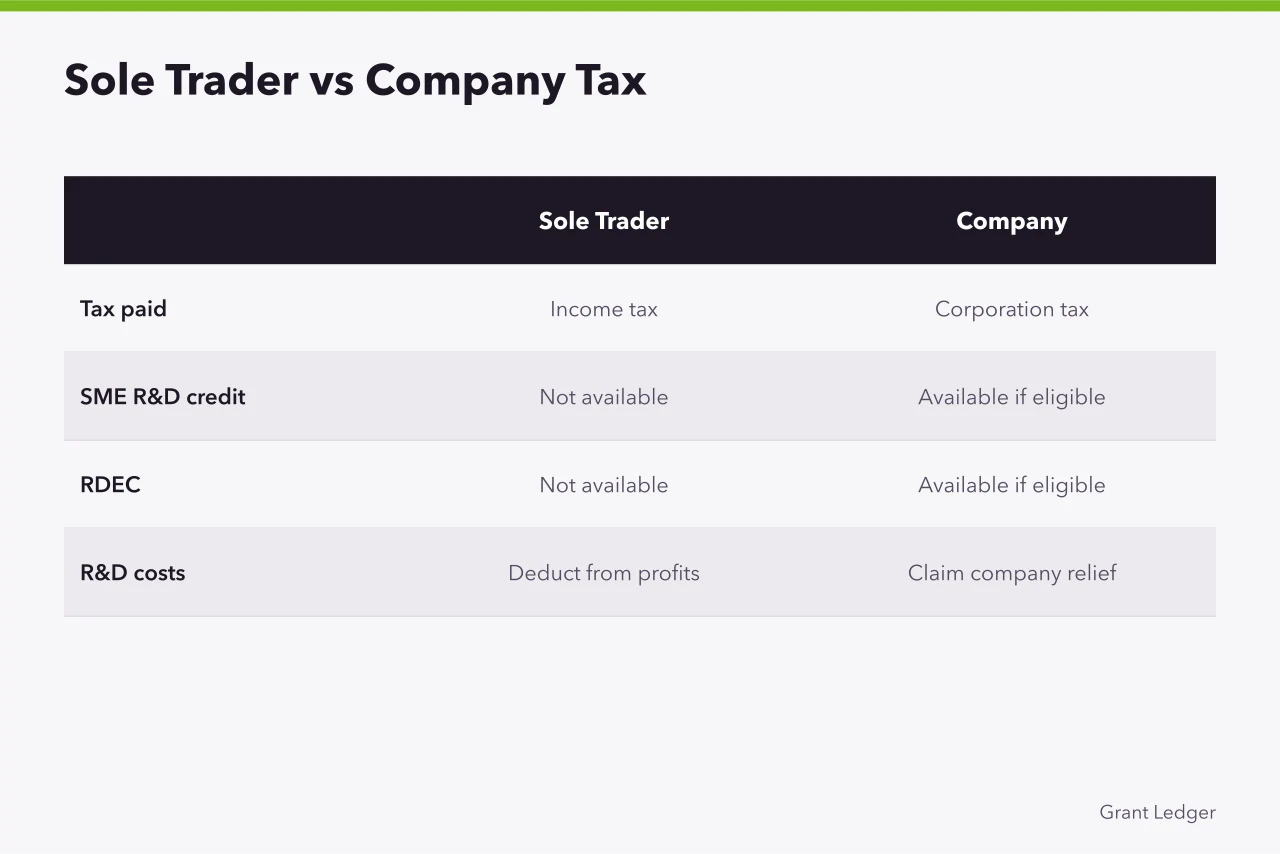
Searches for HMRC R&D tax relief for sole traders often blur the schemes. The distinction is legal, not administrative. An unincorporated business is outside the company tax system for these credits.
What a sole trader can claim instead
A sole trader may deduct allowable revenue costs for R&D from trading profits. Those costs must meet the normal rules for wholly and exclusively business expenses. This can reduce income tax and Class 4 National Insurance contributions, but it is not a tax credit. There is no cash repayment just because the project is R&D.
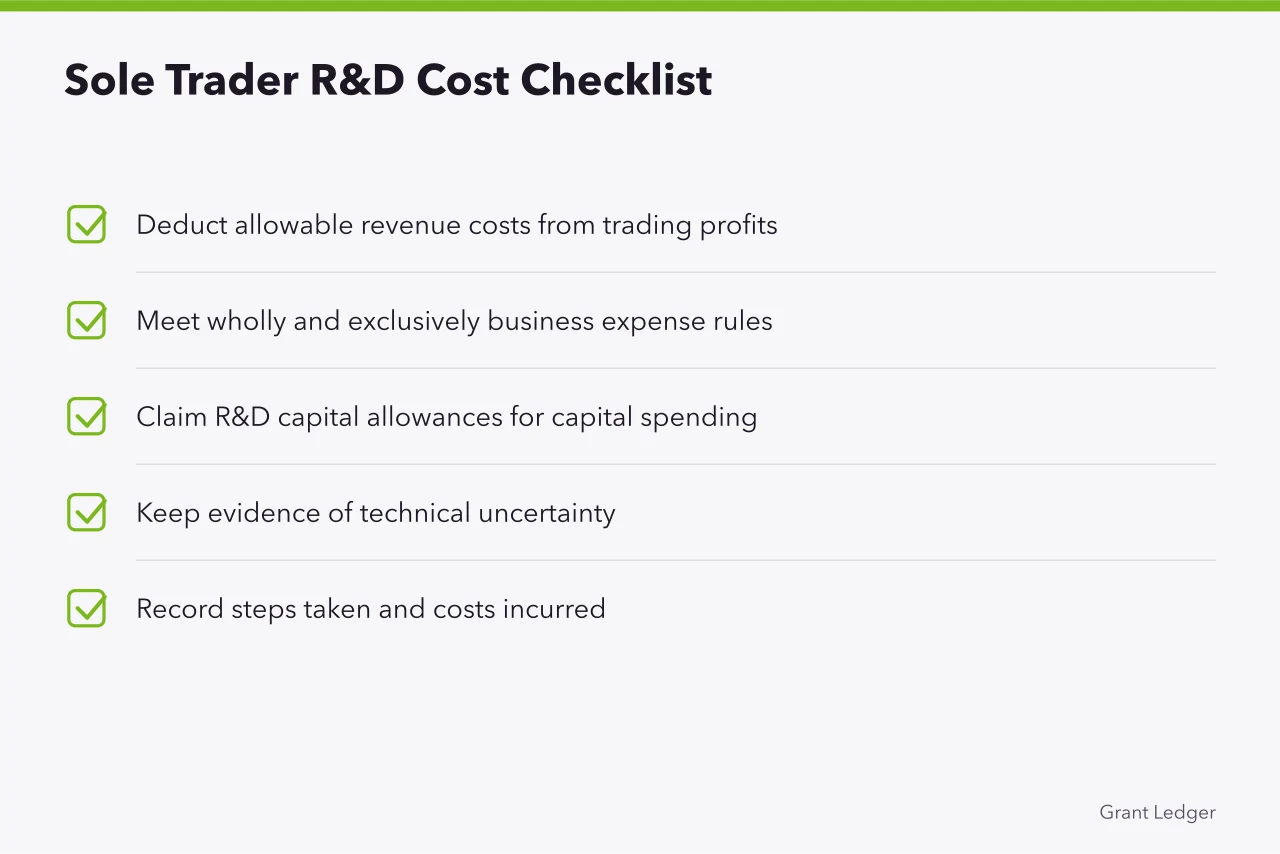
Capital spending on R&D may qualify for research and development allowances. Those are capital allowances, not a payable credit. They can give relief at your marginal income tax rate instead of a company credit rate. Keep evidence of the technical uncertainty, the steps taken and the costs incurred.
If you need broader funding, business finance support lists government-backed finance and grant routes. Some are better suited to early-stage projects than a tax credit claim. Compare start-up loans and business grants before you assume a tax claim is the only option.
The RDEC misunderstanding
RDEC stands for Research and Development Expenditure Credit. It is an above-the-line credit for companies, not for sole traders. A sole trader cannot claim RDEC simply because they cannot claim the SME scheme. The credit is calculated in the company tax computation.
Since accounting periods beginning on or after 1 April 2024, most company claimants use a merged scheme. Loss-making R&D intensive SMEs may use the enhanced R&D intensive support scheme. Both are company routes. They are not personal tax reliefs for the self-employed.
If you read that sole traders must use RDEC, treat that as a warning sign. The statement confuses a company scheme with unincorporated trading. It could lead to an invalid claim and penalties. A qualified adviser should review any scheme advice before you act.
Claiming through a limited company
Some sole traders incorporate and carry out R&D through the company. The company can then claim the merged scheme or, if eligible, R&D intensive support. This can produce a payable credit for a loss-making company, subject to conditions.
Incorporation is not a tax trick. It changes how profits are taxed, how dividends are paid and what records Companies House receives. The company must own the R&D project and bear the costs. You cannot simply invoice your own sole trade into a company claim.
Before incorporating for R&D relief, model the overall tax position. Compare corporation tax, dividend tax, employer duties and accountancy costs. A smaller credit in a company may be worth less than the flexibility of self-employment. Innovate UK runs competitive grant programmes for innovative projects, as described on Innovate UK, and a grant is separate from tax relief. For grant-funded innovation, see how to write an Innovate UK Smart Grants application.
A decision table for common cases
Use this table as a first filter, not as advice on your facts.
| Situation | Main route | Cash credit? |
|---|---|---|
| Sole trader with revenue R&D costs | Deduct allowable expenses from trading profits | No |
| Sole trader with R&D capital costs | Claim R&D capital allowances if conditions are met | No |
| Company that meets SME or merged scheme rules | Claim the relevant company R&D relief | Possibly, if loss-making and eligible |
| Company that is large or outside the SME rules | Claim RDEC or the merged scheme as applicable | Yes, subject to corporation tax |
| Sole trader who incorporates | Company claims if it owns the project and meets conditions | Possibly |
Common questions
Can a sole trader claim R&D tax relief?
A sole trader can claim relief for allowable R&D costs through the income tax system, but not the SME R&D tax credit.
Is RDEC available to sole traders?
No. RDEC is a corporation tax credit for companies, so a sole trader cannot claim it in their own name.
Do sole traders need a specialist adviser?
For a complex R&D claim, yes. This is general guidance only, and individual cases need a qualified adviser.