Strategy
Part of How to write an Innovate UK Smart Grants application
How to write an Innovate UK Smart Grants application
Innovate UK Smart Grants are scored on innovation, impact and project delivery. Here is how to write an application that answers the brief and its cost rules.
What to take away
- Innovate UK Smart Grants are assessed on three criteria: innovation, impact, and project quality and delivery. Build the application around those headings.
- Eligibility is tested before scoring. Innovation category, project length, project size, consortium shape and your ability to fund the balance must all fit the current brief.
- Cost lines must match the categories named in the brief and trace back to a work package, a named person and a month.
- Grant-funded costs cannot also be claimed under the SME R&D tax relief scheme, so plan the grant and the tax position together.
- The competition brief is the rulebook, and the rules change between rounds. Read the live version rather than a saved copy.
Start with the brief, not the form
Innovate UK runs competitions under individual briefs, and the brief outranks any general advice, including this article. Read the eligibility section first and separate every 'must' from every 'should'. The musts decide whether you can apply. The shoulds decide how well you score.
New to the organisation? The Wikipedia entry on Innovate UK explains how the agency sits within UK Research and Innovation and how competitions are commissioned.
The three assessment criteria
Independent assessors score the application against the criteria printed in the brief. They are not judging whether your business is admirable. They are testing whether your answers fit the questions asked.
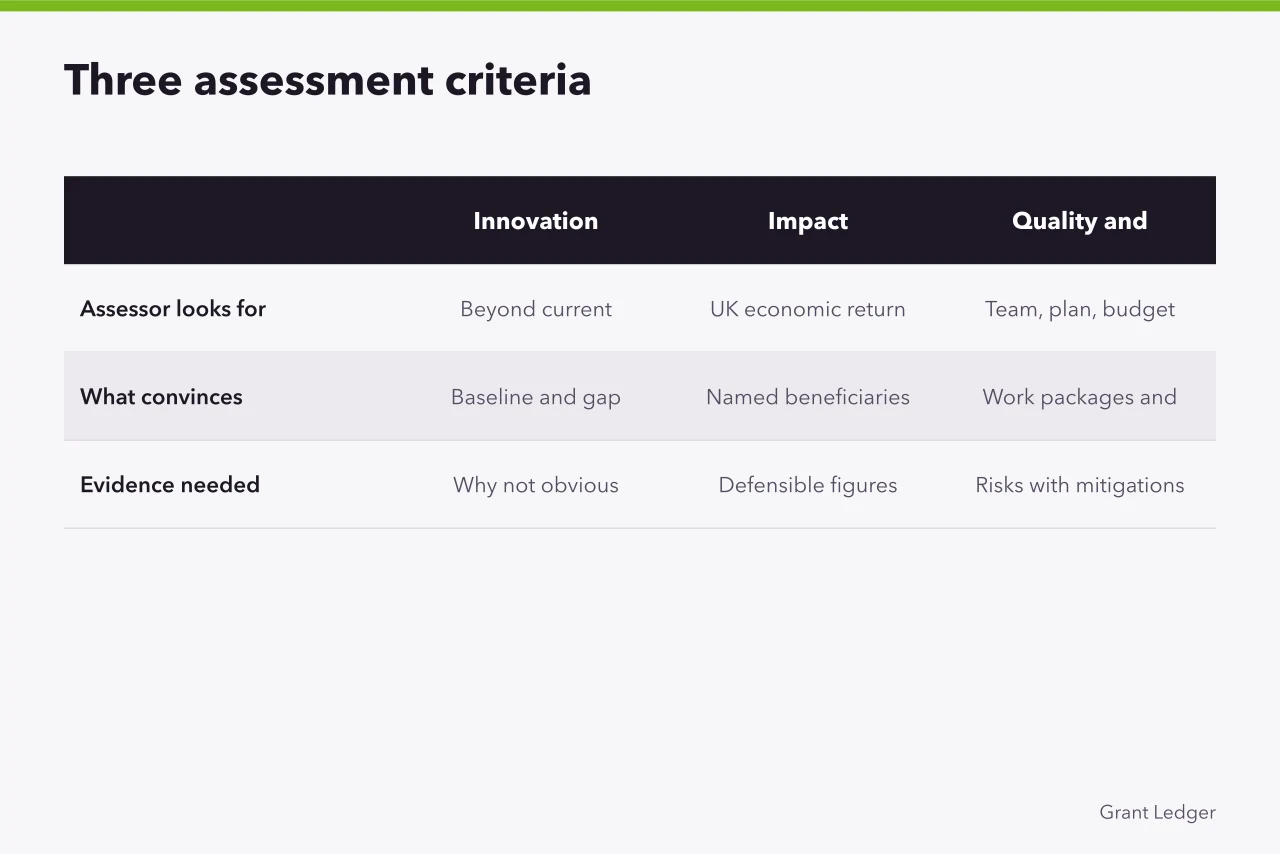
| Criterion | What the assessor is looking for | What convinces them |
|---|---|---|
| Innovation | How the project moves beyond current practice, and why the advance is not obvious | A stated baseline, the gap, and what changes if the project succeeds |
| Impact | The economic or societal return, in the UK and beyond your own business | Named beneficiaries, a route to market, and figures you can defend |
| Quality and delivery | Whether the team, plan, budget and risk register can carry the project | Work packages, named owners, dates, and risks with mitigations |
Some briefs weight the criteria differently, so check the posted scoring before you spend your word count. General grant advice often treats the three as equal, which can leave the heaviest criterion thin.
What counts as eligible project cost
The brief lists eligible cost categories and how each one is calculated. Labour, materials, subcontracting, travel and capital items carry their own rules, and the brief states whether you claim actual costs or use a simplified method.
Costs already covered by the grant cannot be claimed again under the SME research and development tax relief scheme. The GOV.UK guidance on R&D relief explains how subsidised costs are treated, and it is worth reading before you build the budget.
Every cost line should point to a work package and a named person. Assessors notice budgets made of round numbers with no explanation.
A seven-step drafting sequence
A dated plan beats a fortnight of panic. The ninety-day grant schedule sets out that route from project definition to delivery readiness.
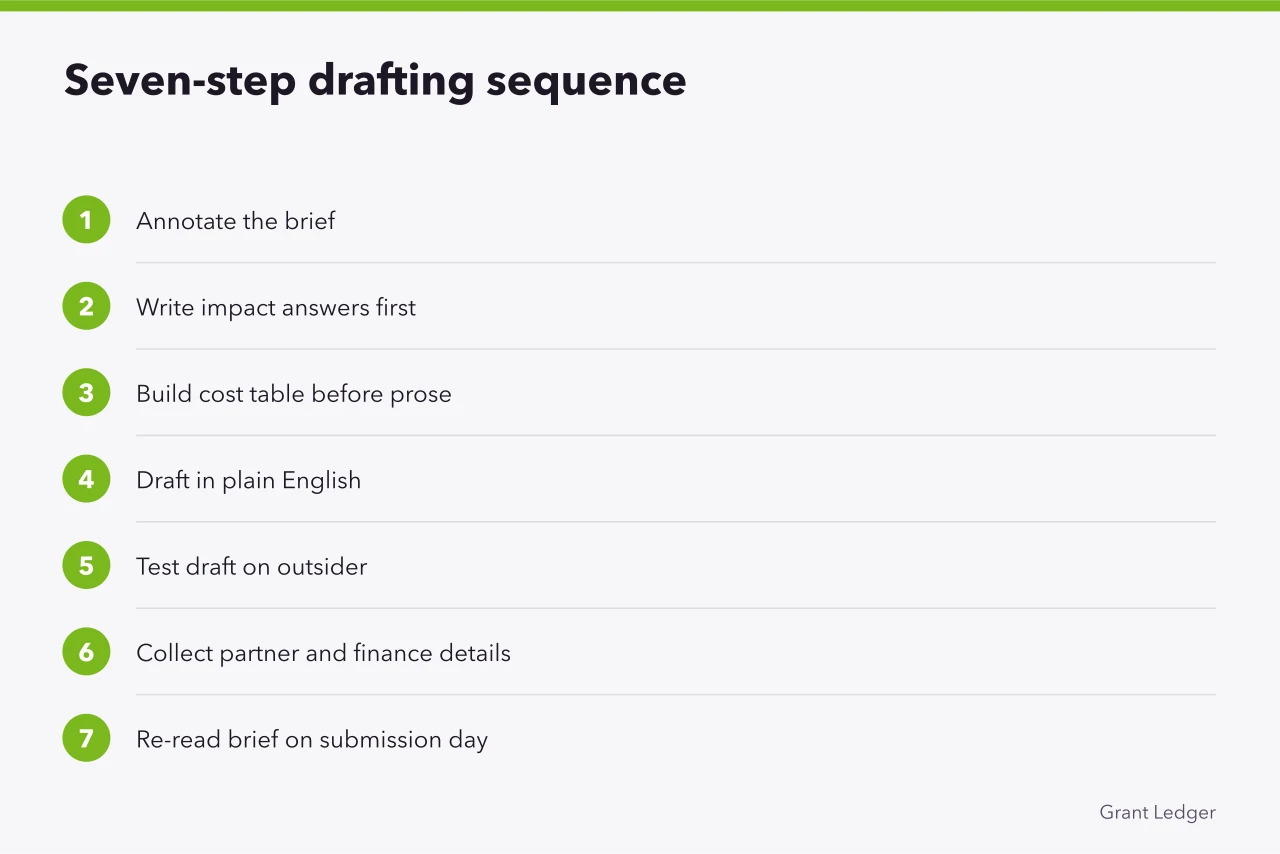
- Annotate the brief. Mark every eligibility rule and every scored question, then keep that annotated copy beside you while drafting.
- Write the impact answers first. Impact is the hardest section to retrofit once the technical story is fixed.
- Build the cost table before the prose. Line each cost against a work package, an owner and a month.
- Draft in plain English. Define each acronym once, then use it, because assessors may not share your sector's shorthand.
- Test the draft on an outsider. Ask what they could not follow, then fix those points rather than polishing the rest.
- Collect partner and finance details early. Consortium declarations and letters of support take longer to gather than the writing does.
- Re-read the brief on submission day. Check file names, page limits and attachments against the checklist before you submit.
Where timelines, match funding and hidden costs bite
Competitions open and close on fixed dates. Work back from the closing time, not the closing date, because the portal is busiest in the final hour.
If the brief funds only part of the project, the balance comes from your own cash, and assessors will ask how you will cover it. The easily missed costs of applying include drafting time, partner paperwork and the gap between award and first payment.
GOV.UK's finance and support finder lists other schemes to check if the competition window has passed.
Common questions
How long does an Innovate UK Smart Grants application take?
There is no fixed answer, so work back from the published deadline. Partner declarations, cost evidence and finance approval usually take longer than the writing itself.
Do I need a partner to apply?
Not always. Some competitions accept single-company bids and others expect a consortium, so read the eligibility rules. Where a partner is needed, agree roles and intellectual property before drafting.
Can I claim R&D tax relief on the same costs?
Costs the grant has already funded are normally excluded from the SME scheme. The R&D relief guidance linked above sets out how subsidised costs are treated.
What happens if the application scores badly?
You usually receive written feedback from the assessors. Use it to strengthen the weakest criterion, since the criteria and the form tend to stay the same between rounds.