Strategy
How to appeal a rejected grant application and request feedback
A rejected grant application is not always final. Learn how to request feedback, spot grant application mistakes and decide whether to appeal or reapply in England.
What to take away
- Most grant rejections are decisions, not verdicts. Check the funder's published appeals route before you write anything.
- Ask for feedback in writing. The answer often reveals a fixable eligibility or evidence gap.
- An appeal challenges process or scoring error. A reapplication addresses weak answers.
- A second attempt works best when you change the evidence, not the wording.
Start with the funder's decision route
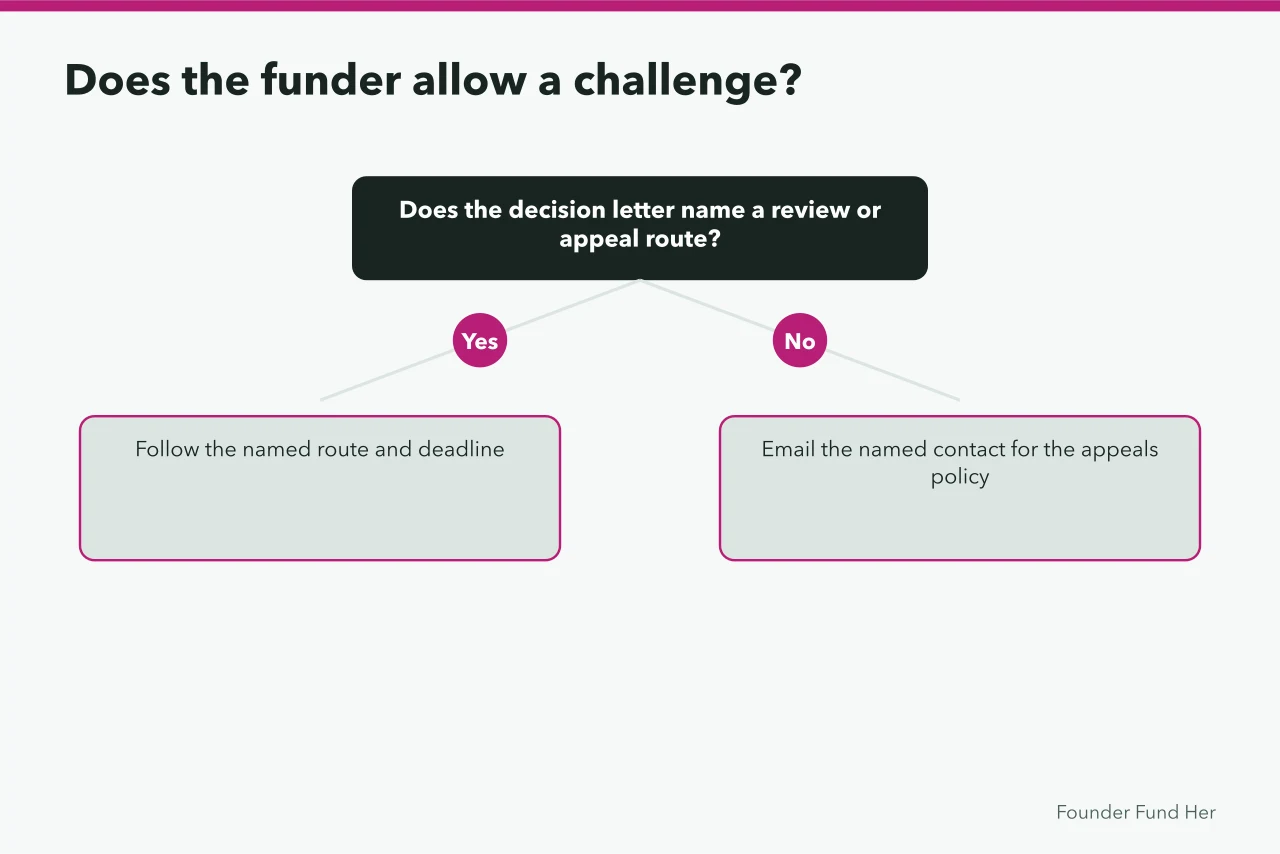
Every grant programme in England sets its own rules. Some allow a review, some allow a formal appeal, and many allow neither. The decision letter or portal message should name the route. If it does not, email the named contact and ask for the appeals policy.
GOV.UK's finance and support page shows how many schemes sit behind different departments. Finance and support for your business identifies the funder. Before you challenge a score, read how to find small business grants for women because eligibility gates vary.
Request grant feedback in writing
Send a short email to the named contact. Ask for the score sheet, assessors' comments and the eligibility decision. Do not argue. Say you want to understand the outcome and improve future applications. That request is how to get grant feedback without turning a review into a dispute.
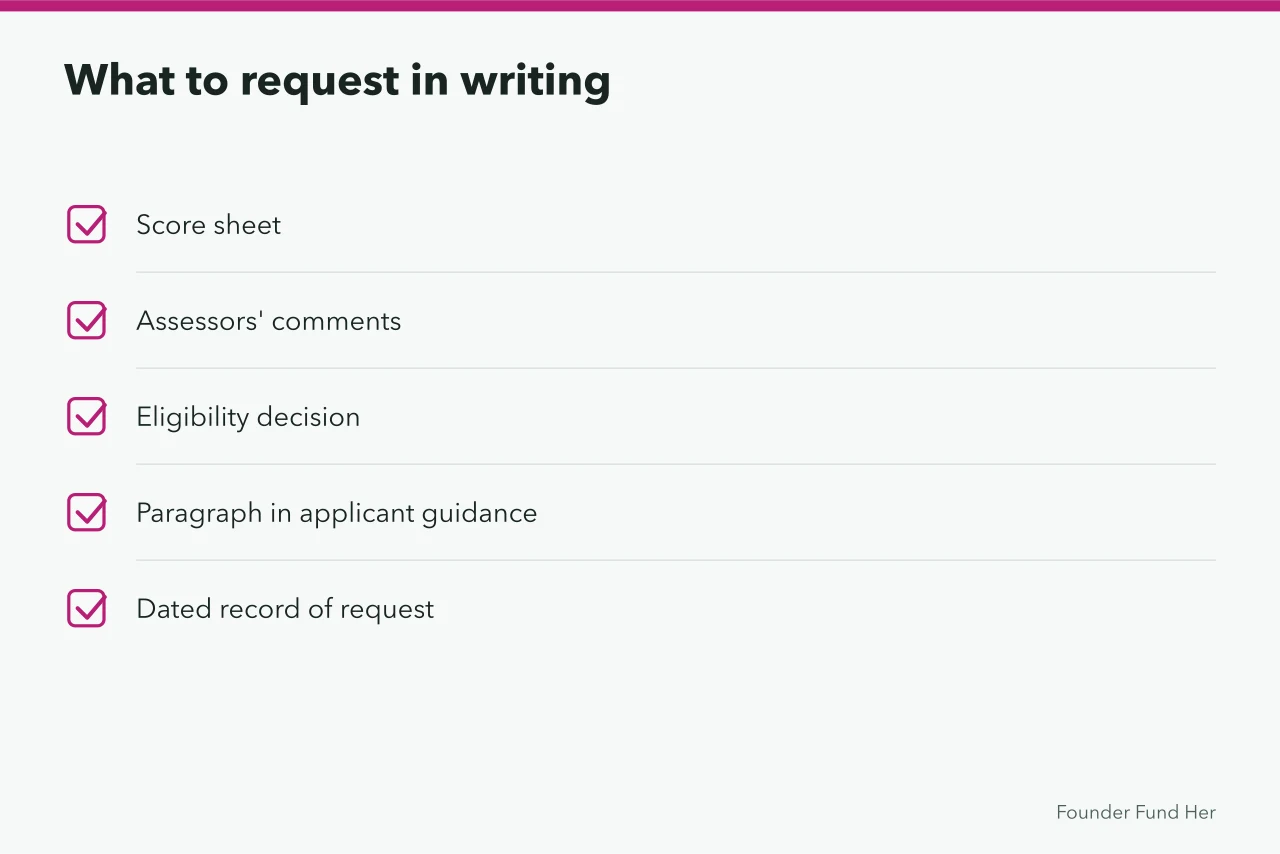
Keep a dated record. Save the rejection letter, portal screenshots and scoring notes. If a funder quotes a rule, ask for the paragraph in the applicant guidance. Innovate UK publishes applicant guidance that explains its assessment process and feedback. Innovate UK funding general guidance for applicants shows the detail a major funder provides.
Fix grant application mistakes before you appeal
Use the feedback to separate three causes: eligibility, evidence and presentation. An appeal rarely fixes a missing document or a weak cashflow forecast. A reapplication can. Work through this sequence.
Fix mistakes before you appeal
- Check the eligibility rules against your business, including company age, turnover and location.
- Match every scoring question to the evidence you supplied.
- List any claim that had no invoice, contract, quote or bank statement behind it.
- Rewrite the weakest two answers with one measurable outcome each.
- Ask a critical reader to mark the new draft against the published criteria.
- Keep the old version so you can show what changed and what stayed.
Decide between an appeal and a reapplication
Appeals usually look at process, not merit. If the panel followed the published criteria, an appeal may fail even if you disagree with the scores. A fresh application lets you answer the same criteria with stronger evidence and a clearer budget.
Appeal or reapplication
Better route
- Rejection cites a rule you can prove you met
- Appeal
- Score sheet shows weak evidence
- Reapply
- You missed a deadline or document
- Wait for a new round
- The scheme is closed
- Find another funder
Why
- Rejection cites a rule you can prove you met
- The funder may have applied its own rule wrongly.
- Score sheet shows weak evidence
- New documents can change the assessment.
- You missed a deadline or document
- An appeal cannot add missing material.
- The scheme is closed
- The budget has gone.
The British Business Bank lists regional funds and delivery partners. Each can set its own review route. British Business Bank is a sensible place to find alternatives if the original scheme is closed.
If two funders give different reasons, compare women founder funding options before you rewrite everything. Keep a log of each decision, the reason given and the date.
Reapply for a business grant with a cleaner case
Reapply when the feedback points to fixable gaps. Update the budget with current quotes and label every pound figure. Explain what changed since the last application. If you added a contract, say when it starts and what it is worth.
Do not resubmit the same document with new adjectives. Most schemes keep old applications. Assessors can compare versions. A short cover note that lists your changes helps.
Check the scheme's cooling-off period. Some funders require a gap of one round or six months. Others accept a new application immediately. The rule should appear in the guidance.
Common questions
How long do I have to appeal a rejected grant application?
Appeal windows are set by the funder, not by a single Act. Many schemes allow 10 to 20 working days from the decision date. Check the decision letter and act before the deadline.
How do I get grant feedback after rejection?
Email the named contact and ask for the score sheet and assessor comments. Keep the request factual and say you want to improve. Some funders release feedback only after the competition closes.
Should I reapply for a business grant UK funders run?
Yes, if the feedback identifies evidence or presentation gaps you can fix. Do not reapply if you were ineligible. Check whether the scheme allows repeat applications and whether a cooling-off period applies.
Can I appeal a grant decision if the funder is a private company?
A private funder can set its own complaints process. Ask for the written policy and follow it. If the funder is regulated, you may have a separate complaints route. Grant merit decisions are often excluded from that route.