Foundations
Part of Business grants for women in England: funding programmes to watch
Business grants for women in England: funding programmes to watch
England-specific funding routes for women founders, from Innovate UK competitions to council growth funds, plus the eligibility checks to run first.
What to take away
- England has no single pot badged as grants for women. The money sits inside national innovation competitions, regional growth funds and council-run schemes.
- Innovate UK's Women in Innovation programme is the most visible England-wide award for women founders, and it runs in competitive rounds rather than as an entitlement.
- Most schemes ask whether the project would happen without public money, alongside the usual checks on company size and trading history.
- Check the government's own finance finder before you pay an adviser, and treat a fee charged to guarantee an award as a warning sign.
- Business rates relief and R&D tax relief are not grants, but they change the cash position that makes a grant worth pursuing.
Where the England-specific money sits
Innovate UK is the national innovation agency, and its Women in Innovation programme is the best known England-wide award aimed at women founders. It opens in rounds rather than continuously, so priorities change with each brief. Entries from England compete against applicants from Scotland, Wales and Northern Ireland.
Combined authorities and county councils run growth funds for local firms, often tied to a postcode or to work delivered in the area. Some reserve places or scoring weight for women-led applicants, but confirm that in the published criteria rather than assume it.
Four routes that carry most of the money
These four routes account for most of the women in business funding open in England in 2025. They differ on who decides, what they fund and how long the money takes to arrive.
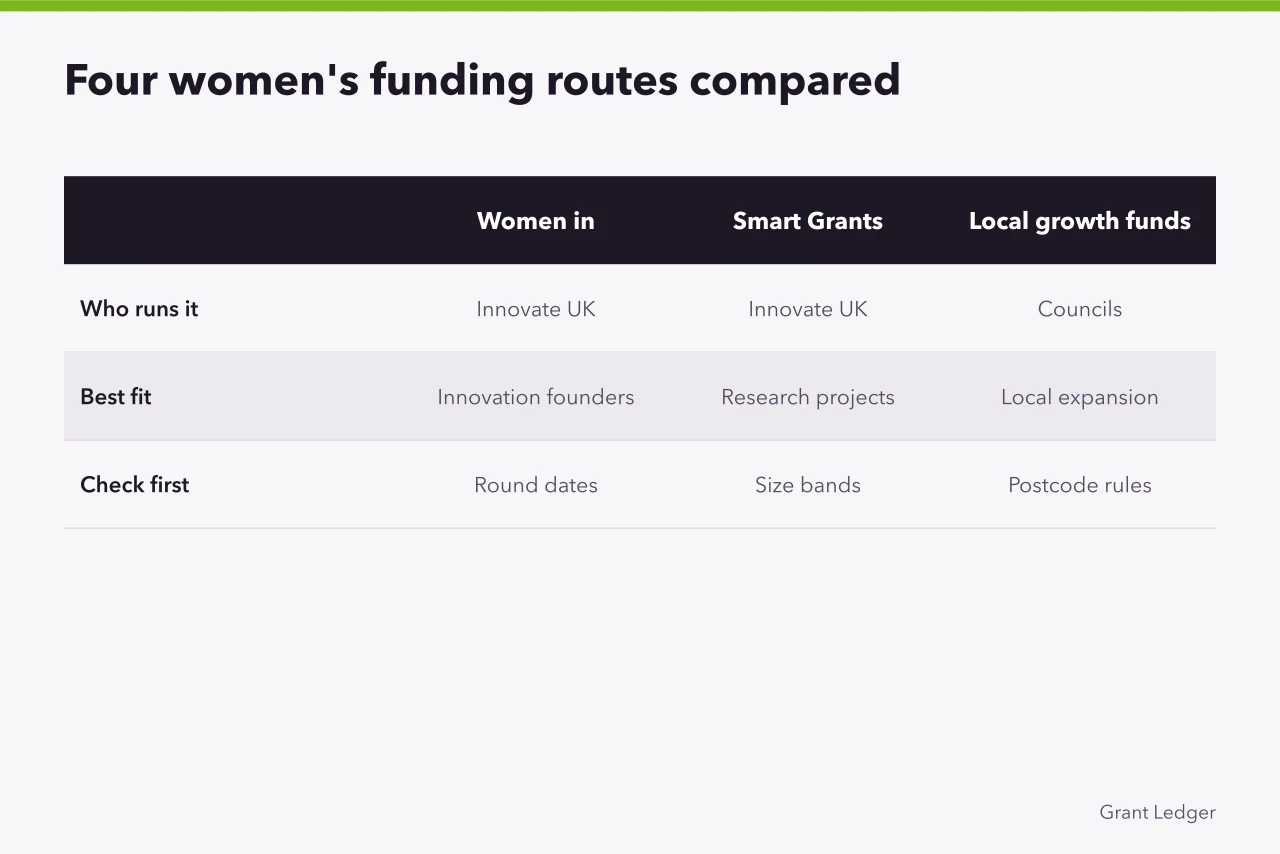
| Route | Who runs it | Best fit | Check first |
|---|---|---|---|
| Women in Innovation Awards | Innovate UK | Women founders developing an innovation | Round dates, sector priorities, what the package covers |
| Innovate UK Smart Grants | Innovate UK | Research-heavy projects with a written plan | Project size bands and your ability to fund work before payment |
| Local growth funds | Combined authorities and councils | Firms trading in the area that need equipment or expansion capital | Postcode rules and whether the fund is currently open |
| Small business rate relief | Billing authority | One property below the rateable value threshold | Your rateable value and whether you already claim it |
If an Innovate UK competition is on your shortlist, the written case is where most bids stand or fall. Our guide to the Innovate UK Smart Grants application breaks down the sections that assessors score.
The eligibility rules that catch women founders out
Trading history is the first filter for most female founder grants in the UK. National competitions often expect a company that is already registered and trading, while local funds are more likely to accept an early-stage applicant.
Legal structure matters too. Some schemes accept sole traders and partnerships, and others require a limited company. The eligibility section always says which, so read that before you draft anything.
Public funding also interacts with subsidy control, so an earlier award can limit what you may accept next. Keep a simple record of every public grant you have received.
How to check a scheme before you spend time on it
Run these checks in order. Each takes minutes and can save weeks on an application that was never going to pass.
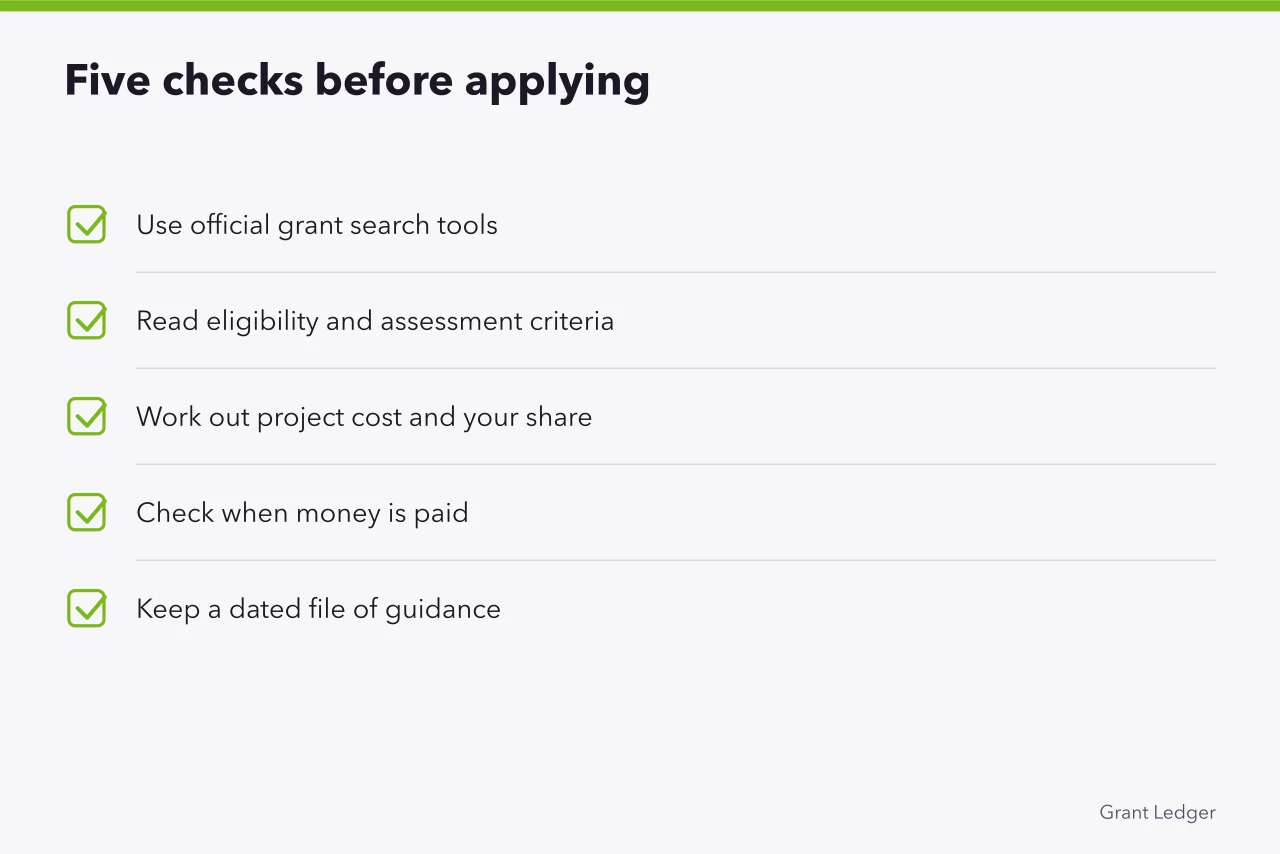
- Start with the official grant search tools rather than a recycled list, then confirm each scheme on the GOV.UK finance and support finder.
- Read the eligibility rules and the assessment criteria first. Case studies are marketing, not rules.
- Work out the total project cost and the share you must fund yourself, including VAT you cannot recover.
- Check when money is paid. Most grants reimburse after you spend, so cash flow matters as much as the award size.
- Keep a dated file of the guidance and any written answers you receive from the funder.
Reliefs that improve the cash position
Small business rate relief can cut or remove the rates bill on a single property in England, and unlike most grants it does not depend on a competitive round. Scotland, Wales and Northern Ireland run their own rates relief schemes with different thresholds.
Research and development tax relief is a company relief rather than a grant, so it sits outside the application timetable and rewards work that resolves technical uncertainty.
Common questions
Do I have to be a woman-only business to apply?
No. Programmes aimed at women usually require a woman in a founder or leadership role, and the remaining criteria match those for any other applicant. Check the definition of founder used in the guidance.
Can a sole trader apply?
Sometimes. Some schemes accept sole traders and partnerships, and others insist on a registered company. The eligibility section states which legal forms are accepted.
Are there grants for women outside London and the South East?
Yes, and local funds are often less competitive than national competitions. Combined authorities and councils across England publish their own growth funds, usually with a postcode test attached.
Does a grant count as taxable income?
It depends on what the money pays for. Revenue grants are normally treated as trading income, while capital grants usually reduce the cost of the asset for tax purposes. Your accountant can confirm the treatment for your circumstances.