Rules and ethics
Advertising women founder funding without tripping financial-promotion rules
Check women founder funding advertising in England for financial-promotion, substantiation, price, eligibility, review and disclosure risks.
Use this checklist for articles, comparison pages, emails, social posts, webinars and affiliate campaigns. The legal route depends on the communicator, audience, product and intended response. Approval by an editor is not regulatory approval.
What to take away
- The legal route depends on the communicator, audience, product and intended response, not on editorial approval.
- A footer saying not advice does not protect a communication whose body urges a transaction.
- Objective claims need evidence and clear material qualifications, and a later disclaimer should not reverse the headline.
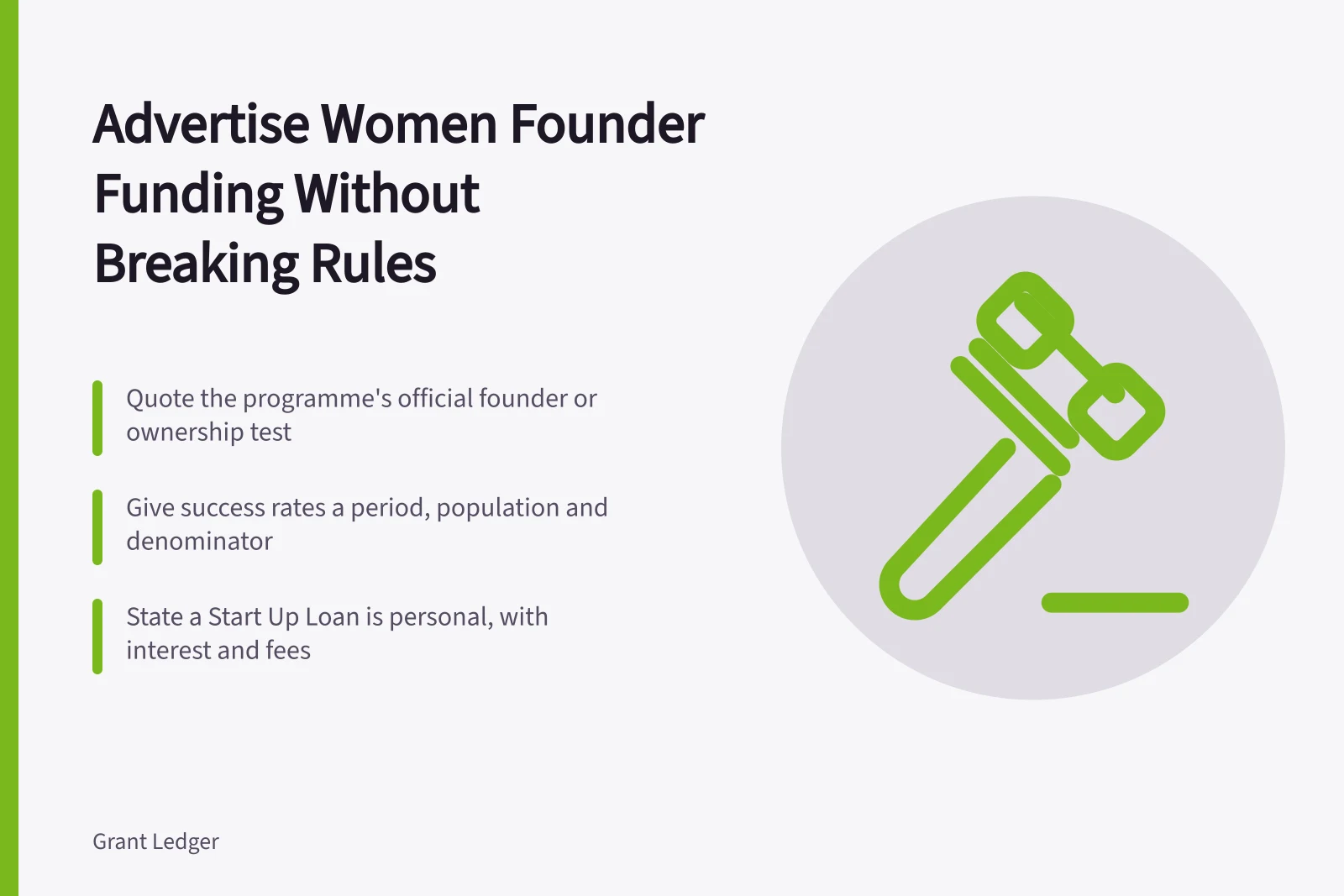
- Targeted women-focused eligibility must quote the official test and must not imply being a woman causes approval.
- Pause live adverts when a rate, deadline, provider status or scheme closes, or the misleading claim stays in circulation.
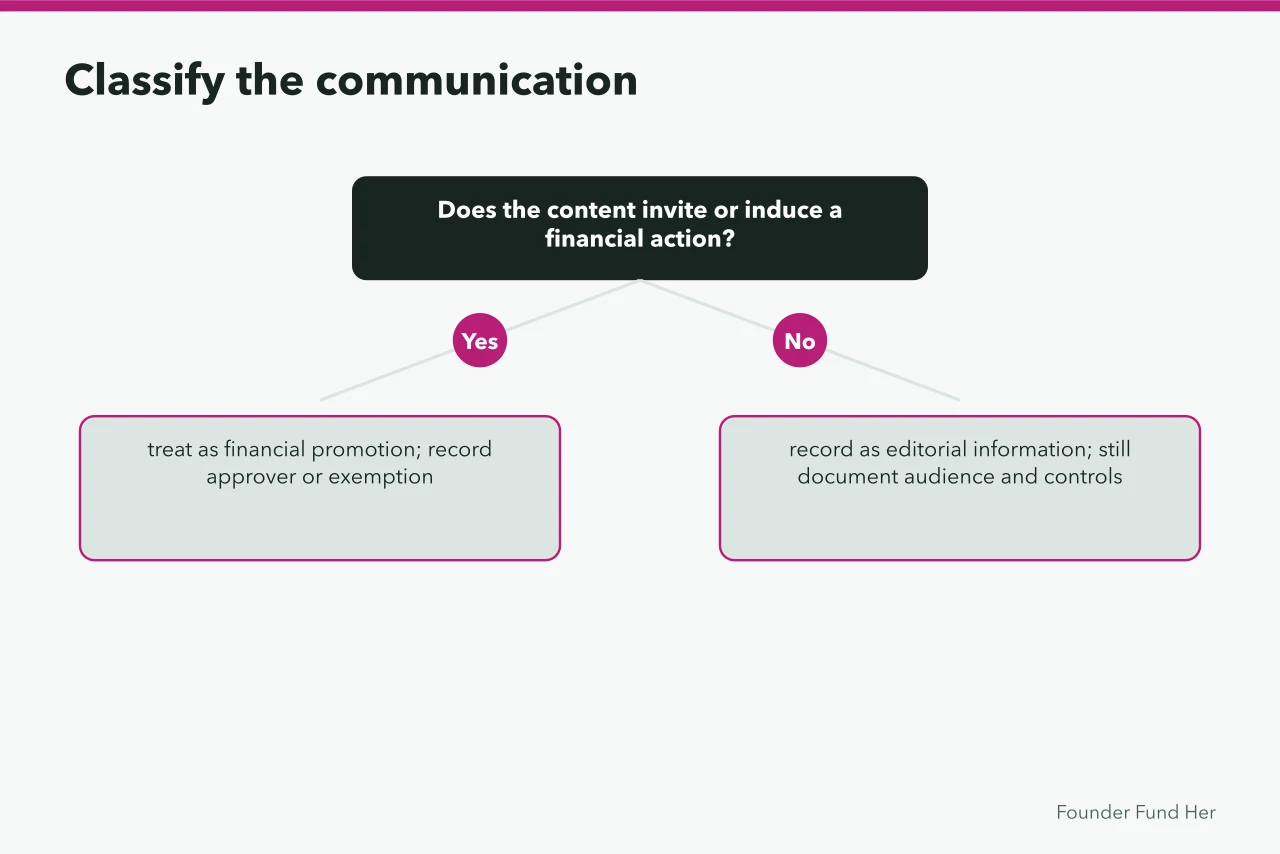
Classify the communication
- Identify the legal entity publishing it.
- Record whether the content invites or induces a financial action.
- Distinguish investment, credit, grant support, business advice and editorial information.
- Define the audience and distribution controls.
- Document any FCA-authorised approver or relied-on exemption.
The FCA PERG 8 perimeter guidance should be read against the actual communication. Do not rely on a footer saying "not advice" when the body urges a transaction.
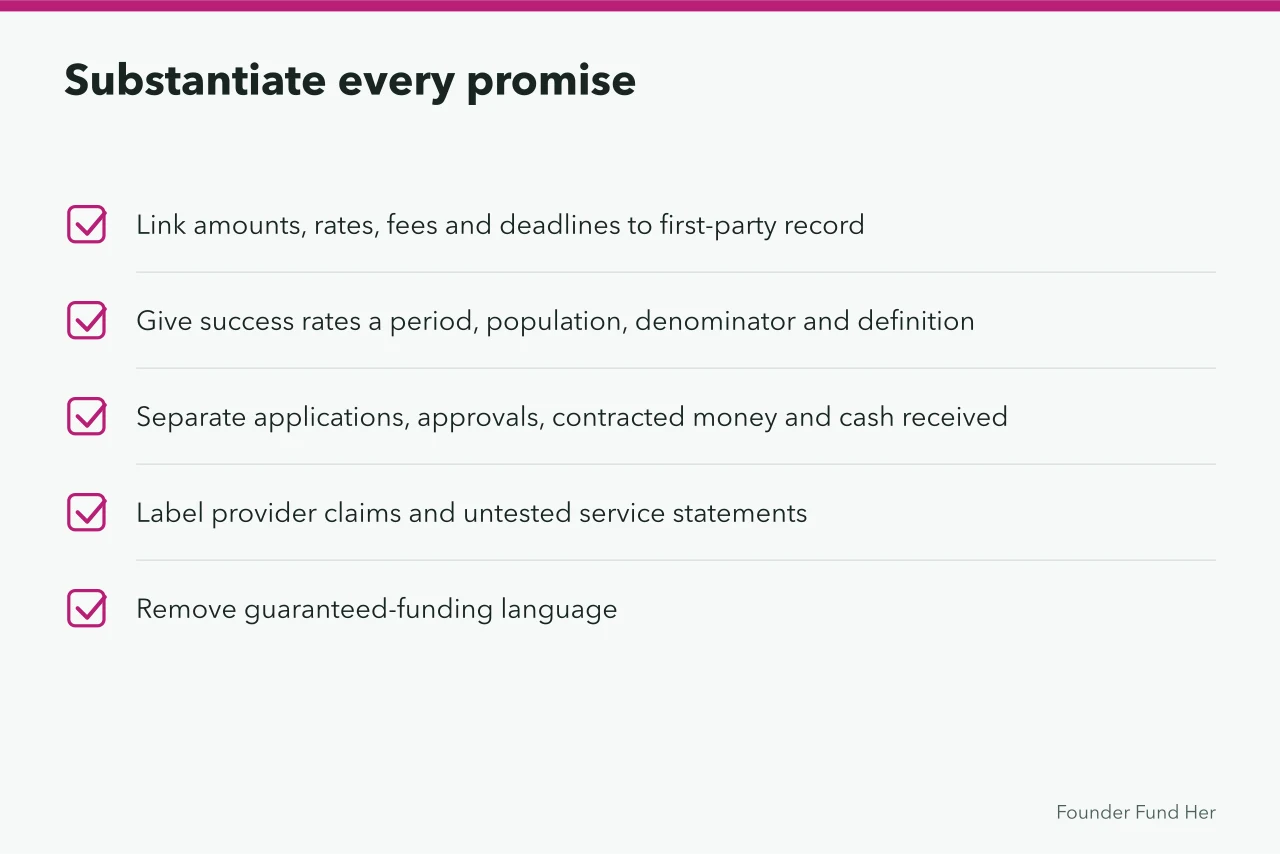
Substantiate the promise
- Link amounts, rates, fees, deadlines and eligibility to the current first-party record.
- Give every success rate a period, population, denominator and definition.
- Separate applications, approvals, contracted money and cash received.
- Label provider claims and untested service statements.
- Remove guaranteed-funding language.
The CAP Code's misleading advertising rules require objective claims to have evidence and material qualifications to be clear. A later disclaimer should not reverse the headline.
Explain financial products clearly
- State that a Start Up Loan is personal when describing the government-backed product.
- Show interest, fees, security or guarantees for debt.
- Explain ownership, rights, dilution and capital risk for equity.
- Describe grant contribution, eligible use, claims and delivery duties.
- Keep unlike cost units separate.
Review the CAP Code's financial-products section and any applicable FCA rules. A best-case "from" rate needs eligibility and pricing context.
Present women-focused eligibility accurately
- Quote the programme's founder, ownership or leadership test.
- Explain how mixed teams are treated if the official record does.
- State geography, stage, sector and closing date.
- Mark a closed opportunity as historic.
- Avoid implying that being a woman causes approval.
Do not use deficit claims about women's confidence, ability or ambition without sound evidence. A targeted programme can address a documented access problem without stereotyping its applicants.
Disclose commercial influence
- Label ads, sponsorship and affiliate content where readers will see the label first.
- State commissions and paid placement near the comparison.
- Publish the provider universe and material exclusions.
- Keep editorial order independent of payment.
- Explain whether the service receives money after an application or completion.
Handle reviews and testimonials
- Use genuine experiences with permission.
- Verify that the person used the service described.
- Disclose incentives and material relationships.
- Do not suppress a review merely because it is negative.
- Date testimonials whose product terms may have changed.
The CMA's unfair commercial practices guidance includes consumer-law treatment of fake reviews and misleading price practices. First determine whether the relevant audience and transaction are within scope.
Sign-off record
Store copy, landing page, audience, source pack, approvals, publication date and next review. Recheck volatile claims on release day. Record complaints and corrections against the exact version.
Test the complete journey
Read the advert on the device and channel a founder will use, then follow every link until personal data or payment is requested. Check that the landing page does not drop the qualification, change the product or introduce a new fee. Test screen-reader order and small-screen prominence for risk and advertising labels.
Senders should also review targeting. A compliant page can still reach an audience outside the approved distribution or eligibility. Preserve campaign settings and exclude groups required by the approval route.
Pause an advert when a rate, deadline, provider status or scheme closes. Correcting the source register without withdrawing the live creative leaves the misleading claim in circulation.
This draft checklist needs a qualified financial-promotions and advertising review before it can be relied upon.
Before you act
- Classify the communication and record the publishing legal entity.
- Link amounts, rates, fees, deadlines and eligibility to the current first-party record.
- State that a Start Up Loan is personal when describing the product.
- Label ads, sponsorship and affiliate content where readers see the label first.
- Store copy, landing page, audience, source pack, approvals and review date.
- Follow every link until personal data or payment is requested.
Common questions
Does editorial approval make a financial promotion compliant?
No. The text states that approval by an editor is not regulatory approval. The legal route depends on the communicator, audience, product and intended response. You should document any FCA-authorised approver or relied-on exemption, and read the FCA PERG 8 perimeter guidance against the actual communication rather than assuming sign-off settles the position.
How should success rates and funding figures be presented?
Give every success rate a period, population, denominator and definition, and link amounts, rates, fees, deadlines and eligibility to the current first-party record. Separate applications, approvals, contracted money and cash received. Label provider claims and untested service statements, and remove guaranteed-funding language. The CAP Code requires objective claims to have evidence and material qualifications to be clear.
What should be checked on the landing page and live campaign?
Read the advert on the device and channel a founder will use, then follow every link until personal data or payment is requested. Check the landing page does not drop the qualification, change the product or introduce a new fee. Test screen-reader order and small-screen prominence for risk and advertising labels, and review targeting and campaign settings.