Tools and providers
Part of Rural business grants in England: what's available now
Rural business grants in England: what's available now
Rural business grants in England sit with DEFRA schemes and local lead authorities, not national directories. Here is what is live and how to check eligibility.
What to take away
- Rural business grants in England sit with DEFRA, upper-tier councils and protected area bodies, not one national list.
- Your postcode decides which local rural pots you can apply to.
- Farm diversification grants run in rounds, with published caps and match funding rates.
- LEADER closed to new applications in England, and its role passed to other programmes.
- Rates relief and R&D relief can help a rural business that wins no grant.
Why national grant lists miss rural firms
National directories are built from open calls that any UK business can apply to. England's rural money rarely works that way. It is allocated to upper-tier councils, combined authorities and National Park authorities, then published on local pages that directories seldom index. A firm in Cumbria and a firm in Devon can face different schemes.
The problem is discovery, not a shortage of money. Rural SMEs often learn about a scheme after its round has closed, or assume that farm grants are only for farms. Diversification into workshops, food production and tourism sits inside several programmes. The government's finance and support finder is a quicker first filter: Finance and support for your business.
Which rural streams are worth checking
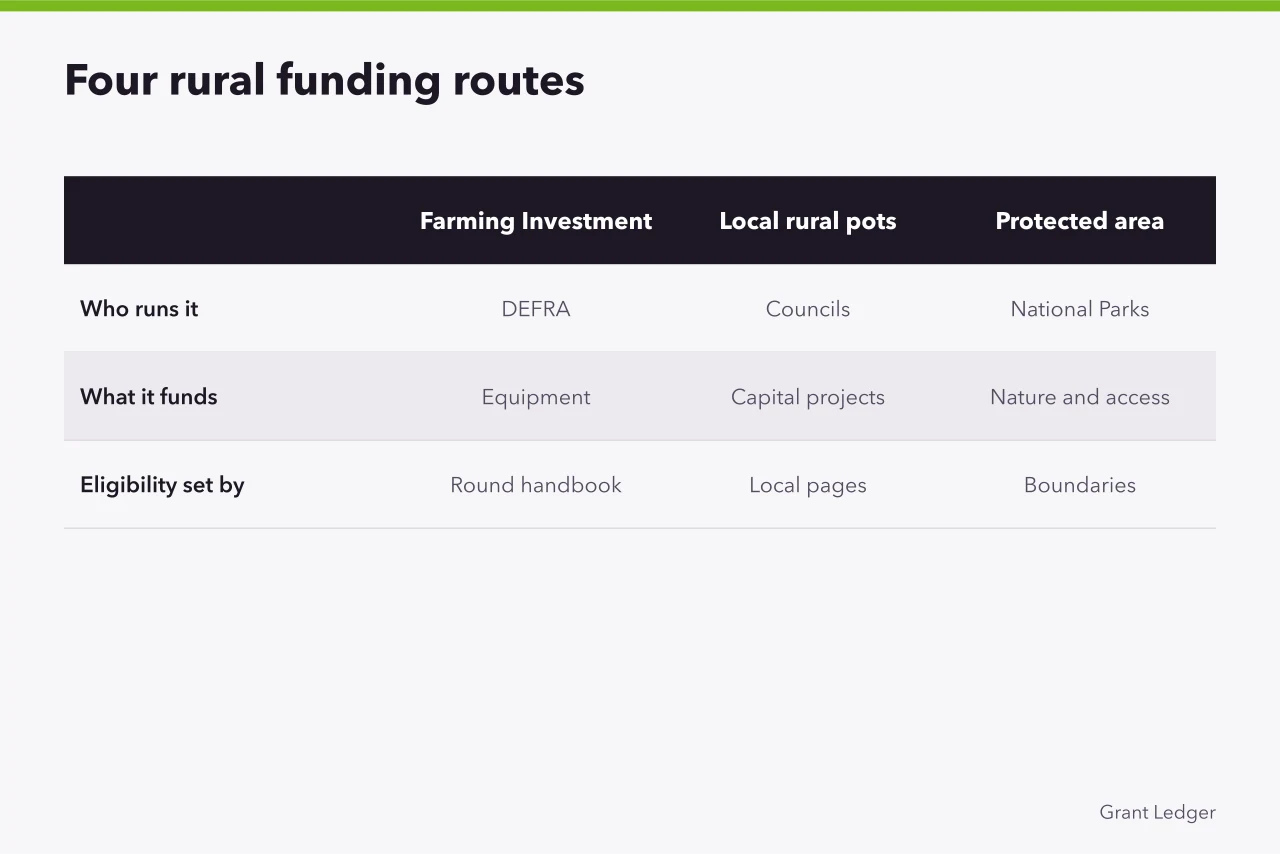
Four routes cover most of what a rural firm in England can apply for, and each has a different owner.
| Route | Who runs it | What it funds | How eligibility is set |
|---|---|---|---|
| Farming Investment Fund rounds | DEFRA, England-wide | Equipment, technology and on-farm productivity | Round handbook lists eligible items, grant caps and match funding |
| Local rural pots | Upper-tier councils and combined authorities | Capital projects, small firm growth, community infrastructure | Local application pages and postcode maps |
| Protected area programmes | National Park authorities and their partners | Nature, access and farm business change | Fixed geographic boundaries, set area by area |
| Innovation routes | Innovate UK and HMRC | New products, processes and R&D projects | Company status, project tests and sector rules |
LEADER is the one people still search for. It ran through Local Action Groups under the Rural Development Programme for England and closed to new applications, though some group pages survive as archives. Check the date on any page before you plan around it.
Its successor was the Rural England Prosperity Fund, allocated to upper-tier councils and combined authorities, with government guidance requiring spending by 31 March 2025. Where that pot has ended, the same councils run rural capital and growth schemes from other budgets.
Check your postcode before you shortlist
Work through these steps before you spend a day on an application.
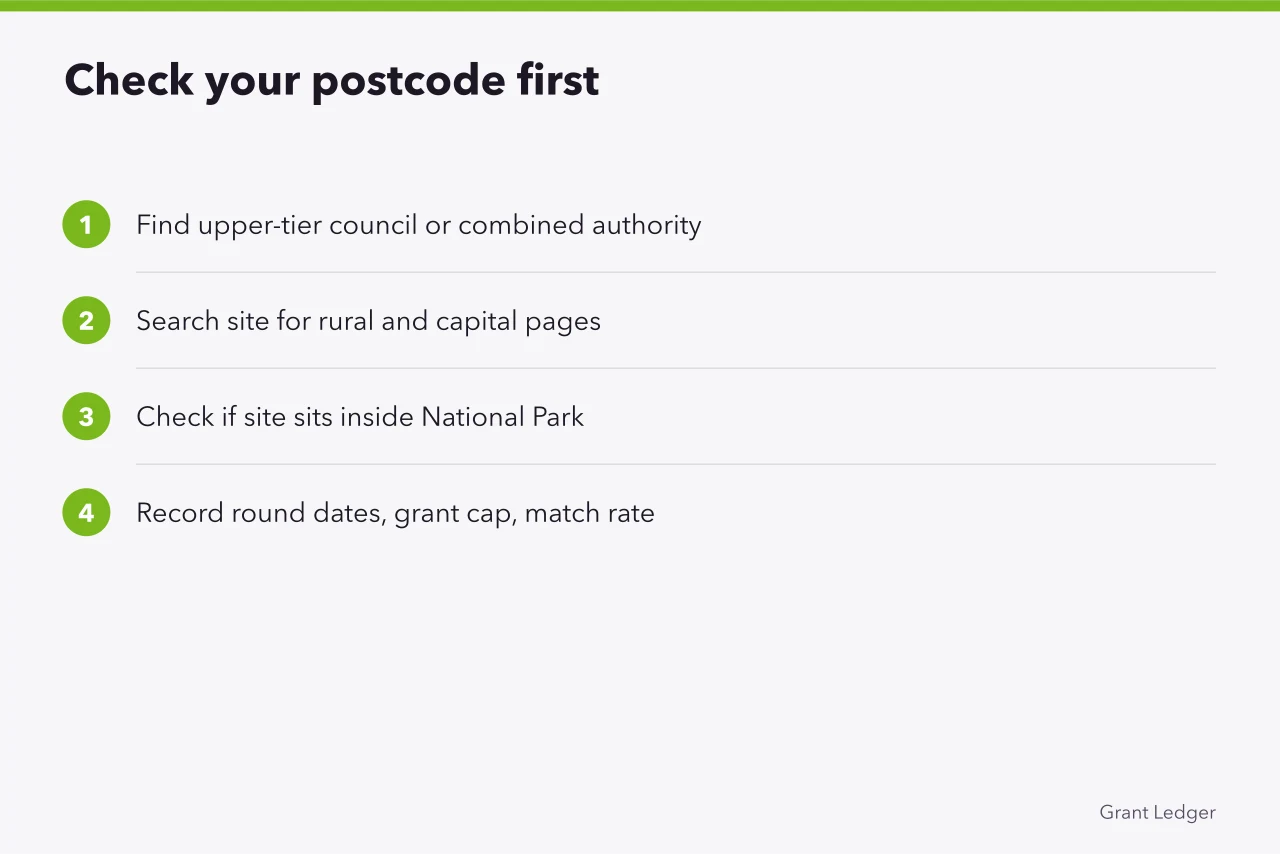
- Find your upper-tier council or combined authority, which holds rural capital budgets for its patch.
- Search its site for rural, capital and business growth pages, then note the last update date.
- Check whether your site sits inside a National Park, which brings a separate programme.
- Record the round dates, grant cap and match funding rate before judging whether the work is worth it.
Match funding decides more than the headline rate
A grant is one of four ways to fund a rural project, and rarely the simplest. Before committing, it is worth comparing grant, loan and equity routes on control, cost and risk, because public money brings reporting duties with it.
Most capital grants pay a share of eligible costs, so you fund the balance and claim after the spend. Cash therefore leaves before it returns, which is where rural projects most often stall.
Reliefs that do not need a funding round
Business rates can fall on a converted barn used as a workshop or farm shop, and small business rate relief in England ties eligibility to rateable value and the number of properties you occupy. Rural rate relief in England is separate, aimed at village shops and pubs in small settlements.
Reliefs lower running costs, but they do not cover the cost of delivering a funded project, from staff time to late claims.
Diversification that builds a new product or process may qualify for R&D tax relief, but only if you trade through a company. HMRC's guidance on Research and Development tax relief sets out the tests, and grant-funded costs are normally excluded.
Common questions
Which rural business grants are open right now?
There is no single list. DEFRA rounds, council pots and protected area programmes open and close on different dates, so check each scheme page and note when it was last updated.
Does LEADER funding still exist for small businesses?
Not as a live fund in England. LEADER ran through Local Action Groups under the Rural Development Programme for England and closed to new applications, and later rural money moved to councils.
Who decides if my postcode is eligible?
Your upper-tier council or combined authority decides for most local pots, and the National Park authority decides for protected area schemes. DEFRA schemes are England-wide but limited by land use.
Can a diversified farm claim a grant and R&D relief together?
Not on the same costs. Grant-funded expenditure is normally excluded from the R&D claim, so keep both calculations separate and keep the evidence.