

Operations
Part of Small business grants operations: running a funded project with one accountable owner
Before grant-funded work starts, a review of scope, cash, suppliers and controls
Run an evidence-led launch review before an England small business starts grant-funded work, checking scope, cash, suppliers, controls and reporting.
A launch review decides whether a funded project is ready to start. It does not re-score the funder's award and it does not review a named grant provider. The review tests whether the recipient can deliver the accepted scope with the agreed money, time, evidence and controls.
What to take away
- A launch review tests whether the recipient can deliver the accepted scope with the agreed money, time, evidence and controls.
- Mark each review area ready, conditionally ready or not ready, and record the reviewer, evidence, exception, owner and due date.
- Mark a purchase not ready when the required award process was bypassed or ordering is proposed before approval.
Review method
Use the final application, offer, signed agreement, approved budget, cash flow, work plan, risk register, supplier file and evidence plan. Rate each area separately and attach the evidence you checked.
Launch review evidence pack
- Final application and offer
- Signed agreement and approved budget
- Cash flow and work plan
- Risk register and supplier file
- Evidence plan
No current programmes or suppliers were tested for this article. The method draws on the Cabinet Office Model Grant Funding Agreement, with a live link below, and must be adapted to the live award.
Scope and outcomes
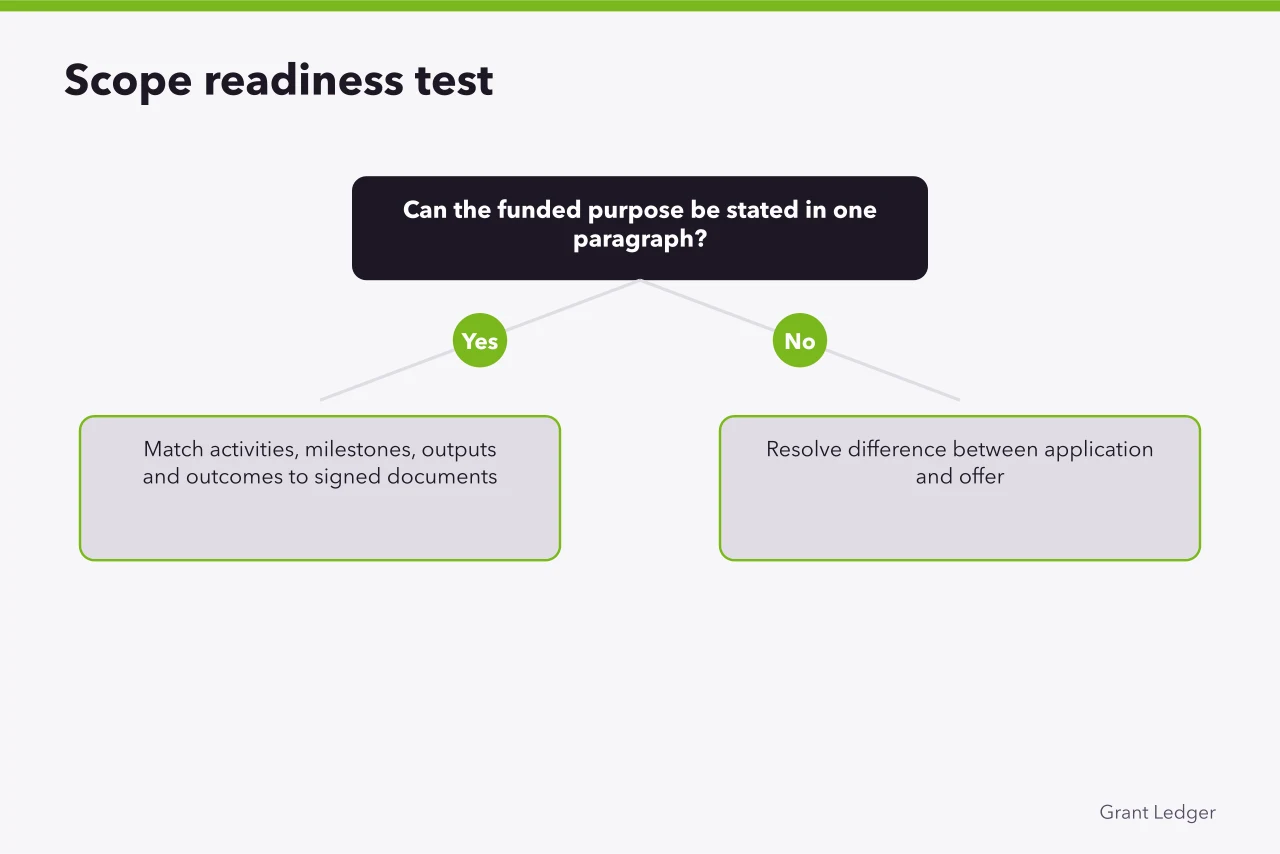
Confirm that the team can state the funded purpose in one clear paragraph. Match activities, milestones, outputs and outcomes to the signed documents. Resolve any difference between the application and offer. The same review applies to awards such as Innovate UK Smart Grants or local growth grants.
The Cabinet Office Model Grant Funding Agreement illustrates funded activities, payment schedules and outcome measures. It is not evidence of a particular recipient's terms.
Rate the area not ready if a major activity lacks an owner, date or acceptance test.
Budget and cash
Reconcile the approved cost headings, grant share, business contribution and other permitted funding. Test VAT assumptions and the largest monthly cash deficit. Check the no-award commitments have ended and the award conditions needed for first payment are met.
Size the largest monthly cash deficit by subtracting monthly grant receipts from monthly costs. Illustrative example: if costs peak at £20,000 and grant receipts are £12,000, the deficit is £8,000. The business must show it can fund that £8,000 until the claim is paid.
Business.gov.uk funding preparation guidance recommends forecasting when cash enters and leaves the bank. A project is not ready when it relies on an unapproved facility or immediate reimbursement that the agreement does not promise.
Suppliers and procurement
Map each planned purchase to quotation, competition, conflict and approval requirements. Review supplier identity, scope, price, timing, contract and acceptance criteria. Check that delivery falls within the funding period. Check the award's procurement rules against the Public Contracts Regulations 2015 where they apply.
Mark a purchase not ready when the process required by the award has already been bypassed or the team proposes to order before approval.
Roles and authority
Name the accountable owner, finance lead, delivery leads, procurement owner, reporting owner and authorised signatory. Confirm deputies and approval limits. Every agreement duty needs a person and evidence route.
Set approval limits in writing: for example, the delivery lead may approve purchases up to £5,000, the finance lead up to £25,000, and the board above that. Treat these as illustrative starting points, not a rule.
The government's grant-agreement guidance expects clear terms for expenditure, reporting, audit, assurance and performance in central government grants. The recipient's team map should cover the duties in its own award.
Evidence and systems
Open the project ledger, evidence register, change log and risk register. Test file permissions, naming and version control. Walk one planned supplier cost from approval to claim and one outcome from activity to report.
Where personal data is involved, record purpose, lawful basis, access, sharing and retention. Use the ICO guidance hub for current UK data-protection guidance.
Reporting and changes
Enter every claim, milestone and report deadline in the operating calendar. Confirm the internal review lead time and funder submission route. Give staff a written process for scope, supplier, cost or timing changes.
A project is conditionally ready when a minor action has a credible owner and date before the affected work. It is not ready when a material agreement question remains unresolved.
Decision record
Summarise red conditions, cash exposure, highest risks and required approvals. The accountable owner signs the launch decision after reading the exceptions. Do not convert an unresolved red item to green because a public announcement has been scheduled.
Worked example: a supplier purchase above the award's quotation threshold had only one quote. The completed decision record entry reads: Red condition: procurement competition not evidenced. Owner: finance lead. Due date: 30 June 2026. Required action: obtain two further written quotes before order. Reviewer: procurement owner. The area stays red until the quotes are on file.
Repeat the review after a material variation or long mobilisation delay.
Before you act
- Use the final application, offer, signed agreement and approved budget.
- Reconcile cost headings, grant share and business contribution.
- Map each planned purchase to quotation, competition and approval requirements.
- Name the accountable owner and authorised signatory.
- Enter every claim, milestone and report deadline in the operating calendar.
- Repeat the review after a material variation or long mobilisation delay.
Common questions
What documents should a launch review use?
Use the final application, offer, signed agreement, approved budget, cash flow, work plan, risk register, supplier file and evidence plan. Mark each area ready, conditionally ready or not ready, and record the reviewer, evidence, exception, owner and due date.
What should the decision record summarise?
Summarise red conditions, cash exposure, highest risks and required approvals. The accountable owner signs the launch decision after reading the exceptions.